![housecleans[1]](https://lovingmylot.com/wp-content/uploads/2013/09/housecleans1.jpg) The first time I saw these five words on the cover of a book they looked as tantalizing as a cream-filled doughnut. If there’s one idol I’ve battled for years, it’s the idol of wanting a perfectly tidy home. For some reason my mom has always had this innate Mary Poppins-like ability to create order out of chaos. As a result I grew up in a beautifully organized home that ran like a well-oiled machine. And then I got married, moved into my own little house, and made two startling realizations: Keeping an entire house clean is crazy hard, and I have no idea how my mother did it. Suffice to say it didn’t get any easier when I added two children and 85,000 articles of doll clothing. Plus accessories.
The first time I saw these five words on the cover of a book they looked as tantalizing as a cream-filled doughnut. If there’s one idol I’ve battled for years, it’s the idol of wanting a perfectly tidy home. For some reason my mom has always had this innate Mary Poppins-like ability to create order out of chaos. As a result I grew up in a beautifully organized home that ran like a well-oiled machine. And then I got married, moved into my own little house, and made two startling realizations: Keeping an entire house clean is crazy hard, and I have no idea how my mother did it. Suffice to say it didn’t get any easier when I added two children and 85,000 articles of doll clothing. Plus accessories.
Over the years I’ve felt all sorts of things when it comes to housekeeping—guilt, frustration, and at times the ungodly desire to morph into a barking drill-sergeant. Which is why I was so taken aback to read this statement in Clark’s book: “The startling truth is that cleaning really shouldn’t have any emotional component at all. It’s not an emotional subject. It’s just a necessary set of tasks. If the thought of cleaning house evokes any [strong] emotion…it’s time to unpack that baggage and see what’s in there. It’s making housekeeping, which is just a necessary part of life, much more difficult than it needs to be.”
Right off the bat this helped me make it through the rest of Clark’s book, because let me just warn you, the woman is detailed. But if you can let go of the emotional component, you’re free to apply the principles you like and not feel guilty for ignoring the ones that are beyond your stamina. That being said, here are my 3 favorite principles from her book (re-phrased in my own words):
1. Don’t just tidy, figure out what’s causing the mess and problem-solve. To do this, you have to analyze the way mess accumulates in your particular home. For instance, there’s always a pile of books on the end table in our den, usually dirty socks on the floor, and a huge {amazingly comfortable} blue chair that’s crusted over with sticky handprints. Normally I ignore the books, take the socks to the laundry room, and wash the blue slip cover every few weeks. After thinking like a problem-solver, I designated a basket for the books we’re currently reading, stowed a hamper discreetly in the den, and made a new rule—no one under twenty-five gets to eat in the blue chair! By the time I problem-solved my way through the whole house, the mess had begun to reduce itself rapidly.
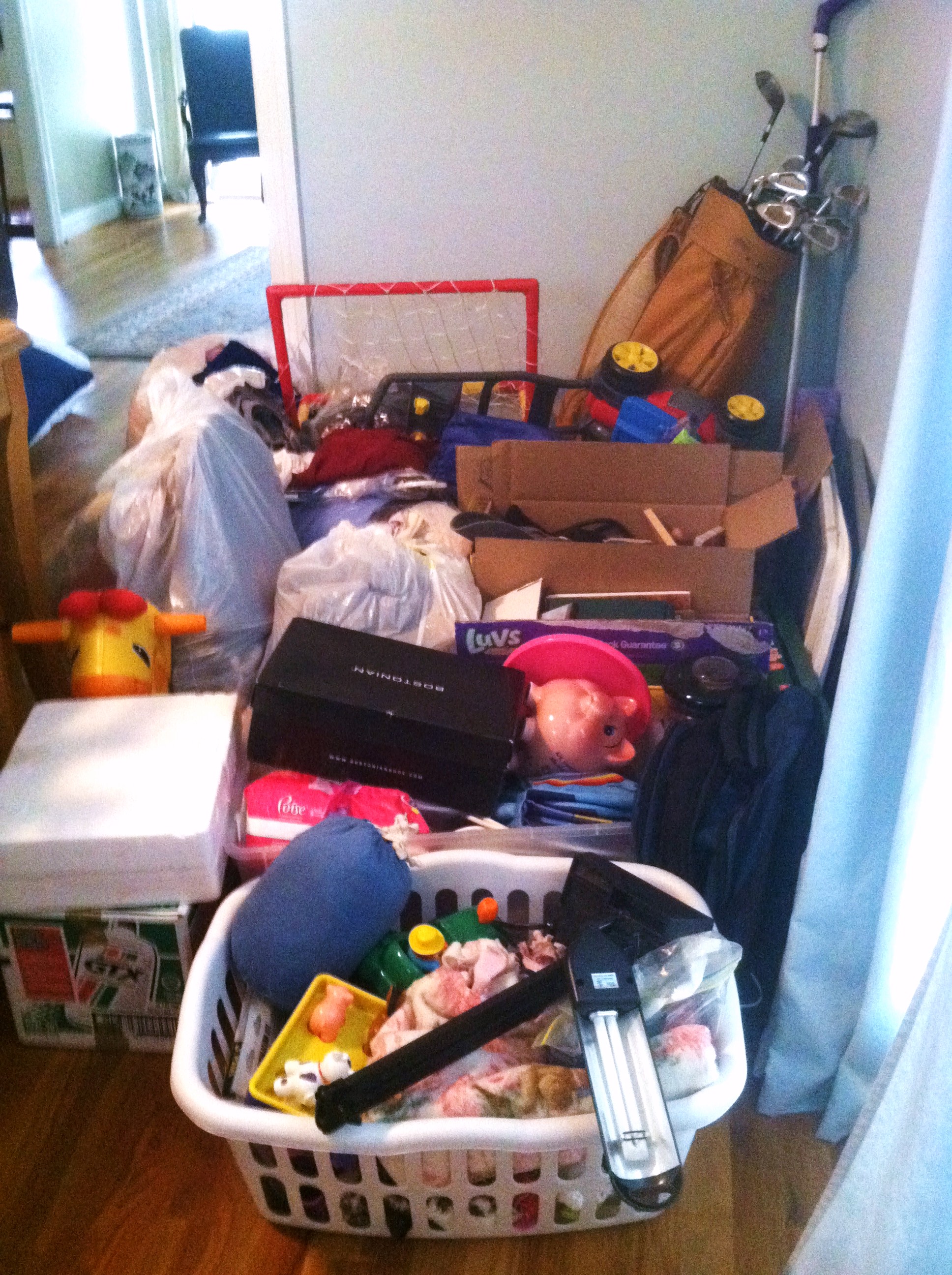
2. Get rid of as MUCH as possible. Clark taught me to view every single object in my house as owning a piece of my time. Furniture, paper clips, Barbie shoes, that monogrammed bridesmaid gift in the attic—everything. The question you have to ask is: Is this object worth the time it takes to clean it, dust it, straighten it, pick it up, pack and move it? The simple truth is, the less you have the easier it is to maintain order.
3. Create a “launching pad” and eliminate “rabbit trails.” Two of the most common ways mess accumulates is in the entryway of your home and in the pursuit of what Clark calls “rabbit trails.” A rabbit trail is any activity you frequently embark upon that requires supplies from around the house. For instance, I store wrapping paper in the upstairs guest bedroom closet, simply because there’s room for it there. But of course, the tape and scissors are downstairs in the study, and I actually wrap gifts on the dining room table. Once I’ve gathered all the supplies and wrapped my gifts, what’s the likelihood that I will put them all back where they belong before next Christmas? Moderate to low. Clark’s solution is to set up “stations” wherever the task is accomplished. In my case, there should be a large container with all the supplies necessary to wrap presents stored out of sight somewhere in the dining room.
To help out your entryway, Clark suggests a “launching pad”–a cabinet, bookcase, closet, or shelving unit somewhere near the main entryway that holds all the items you enter and exit with on a regular basis (wallet, purse, sunglasses…etc.) If your kids are school-aged, they can each have their own bin in the launching pad to hold things like backpacks and library books. This is a fast way to stop the clutter as it comes in the door, and to keep from losing important items.
All in all, I loved the improvements Clark’s book brought to our home. If you have the time and energy, I’d recommend buying it and giving her system a shot. Take it with a BIG grain of salt, use what you like, ignore what you don’t, and thank God for the gift of a home—messy, clean, calm, and crazy.
You May Also Like:































 Loving My Lot